When you are involved in a car accident in the United States, one of the most confusing parts is understanding how the insurance system actually turns your claim into a settlement payment. Many accident victims expect a quick payout, but in reality, the accident settlement process USA follows a structured series of steps involving investigation, negotiation, documentation, and legal evaluation.
This guide explains the entire process in detail so you understand exactly how insurance companies decide how much to pay, what affects your settlement value, and how you can protect your rights at every stage.
1. Understanding the Accident Settlement Process in the USA
The accident settlement process USA refers to how insurance companies handle claims after a car crash, injury incident, or property damage event. The goal is to determine:
- Who is at fault
- How much damage occurred
- What medical costs and losses were caused
- How much compensation should be paid
The process can involve:
- Insurance adjusters
- Medical providers
- Attorneys (in some cases)
- Independent investigators
- Sometimes, the court system if no agreement is reached
Most claims are settled outside of court, but understanding the steps helps you avoid lowball offers and delays.
2. Step 1: Accident Occurs and Immediate Actions
Everything starts at the accident scene. What you do here directly affects your claim value later.
Key actions after an accident:
- Call 911 if there are injuries
- Seek medical attention immediately
- Take photos of the accident scene
- Collect witness information
- Exchange insurance details with the other driver
Insurance companies rely heavily on early evidence. If you delay documentation, it may reduce your compensation later in the accident settlement process USA.
3. Step 2: Filing the Insurance Claim
After the accident, you must file a claim with either:
- Your insurance company (first-party claim), or
- The at-fault driver’s insurance (third-party claim)
Information required includes:
- Accident report number
- Photos and videos
- Medical records (if available)
- Vehicle damage estimates
- Witness statements
Once the claim is filed, the insurance company assigns a claims adjuster.
4. Step 3: Insurance Company Investigation
This is one of the most important phases of the accident settlement process USA.
The insurance adjuster investigates:
- Who caused the accident
- Whether policy coverage applies
- Severity of injuries and damage
- Consistency of witness statements
- Police report findings
They may:
- Interview drivers and witnesses
- Review traffic camera footage
- Inspect vehicle damage
- Request medical documentation
The insurer uses this information to determine liability and potential payout limits.
5. Step 4: Medical Evaluation and Documentation
If you were injured, medical documentation becomes a major factor in your settlement value.
Insurance companies evaluate:
- Emergency room visits
- Diagnostic tests (X-rays, MRI, CT scans)
- Physical therapy costs
- Prescription medications
- Long-term treatment needs
They also assess:
- Whether injuries are temporary or permanent
- Whether pre-existing conditions are involved
- Whether treatment is consistent and timely
The stronger your medical records, the higher your potential compensation in the accident settlement process USA.

6. Step 5: Property Damage Assessment
Vehicle damage is usually assessed separately from injury claims.
Insurance adjusters consider:
- Repair estimates from auto shops
- Vehicle pre-accident value
- Cost of replacement vs repair
- Salvage value (if totaled)
If the repair costs exceed a certain percentage of the car’s value, it may be declared a total loss, leading to a payout based on market value.
7. Step 6: Calculation of Settlement Value
Once investigation and documentation are complete, the insurer calculates the settlement value.
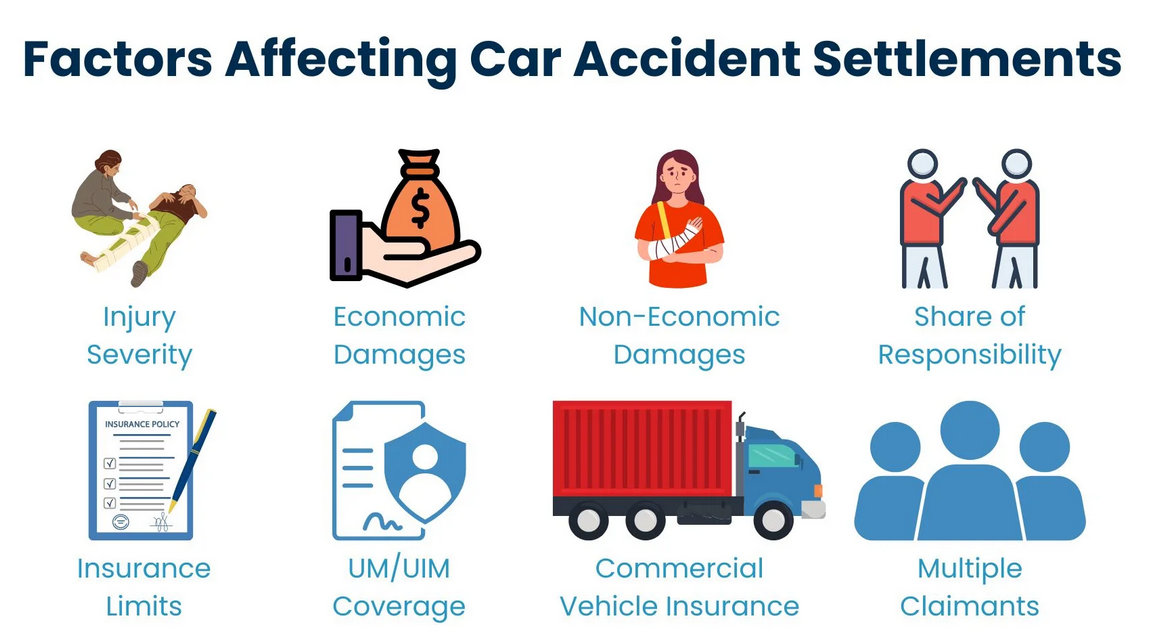
Common factors include:
1. Medical expenses
All current and future treatment costs.
2. Lost wages
Income lost due to inability to work.
3. Property damage
Vehicle repair or replacement costs.
4. Pain and suffering
Non-economic damages like emotional distress, trauma, or reduced quality of life.
5. Liability percentage
If you are partially at fault, your settlement may be reduced.
Insurance companies often use internal formulas to estimate non-economic damages, which is why initial offers are sometimes lower than expected.
8. Step 7: Initial Settlement Offer
After calculating damages, the insurance company presents a settlement offer.
This is often the first major negotiation point in the accident settlement process USA.
Important things to know:
- The first offer is usually low
- It is designed to test if you will accept quickly
- It may not include future medical expenses
You are not obligated to accept the first offer.
9. Step 8: Negotiation Phase
Negotiation is a critical stage where many accident victims increase their compensation significantly.
You (or your attorney) may:
- Submit counteroffers
- Provide additional medical evidence
- Challenge liability findings
- Highlight long-term injuries
Insurance companies may:
- Increase the offer gradually
- Request more documentation
- Delay negotiations to reduce payout pressure
This stage can last weeks or even months depending on case complexity.
10. Step 9: Settlement Agreement
Once both parties agree on a number, a settlement agreement is signed.
This document typically states:
- Final compensation amount
- Release of liability (you cannot sue later)
- Payment timeline
- Claim closure terms
Once signed, the case is officially closed.
11. Step 10: Payment Processing and Payout
After agreement, the insurance company processes payment.
Typical payment methods:
- Check mailed to claimant
- Direct deposit (less common)
- Payment to medical providers (if liens exist)
Payment usually arrives within 2–6 weeks, depending on the insurer.
If attorneys are involved, they deduct fees and distribute the remaining amount.
12. What Can Delay the Accident Settlement Process USA
Several factors can slow down your claim:
1. Disputed liability
If both drivers blame each other.
2. Severe injuries
Long-term medical treatment increases evaluation time.
3. Incomplete documentation
Missing records or evidence delays approval.
4. Insurance company tactics
Some insurers intentionally delay to pressure lower settlements.
5. Multiple parties involved
Accidents with several vehicles take longer to resolve.
13. Common Mistakes That Reduce Settlement Value
Many accident victims unintentionally reduce their compensation.
Avoid these mistakes:
- Accepting the first offer too quickly
- Not seeking immediate medical treatment
- Giving recorded statements without legal advice
- Posting accident details on social media
- Failing to document injuries properly
Each of these can significantly impact your payout in the accident settlement process USA.
14. When You Should Hire a Lawyer
While minor accidents may be handled independently, legal help is often necessary when:
- Injuries are serious
- Liability is disputed
- Insurance company denies the claim
- Settlement offer is too low
- Multiple parties are involved
A personal injury attorney can often increase settlement value by negotiating more aggressively and presenting stronger evidence.
15. Average Timeline of Accident Settlements in the USA
The timeline varies widely:
- Minor accidents: 2–8 weeks
- Moderate injury cases: 2–6 months
- Serious injury or disputed cases: 6 months to 2+ years
The complexity of medical treatment is the biggest factor affecting timing.
16. Final Thoughts on the Accident Settlement Process USA
The accident settlement process USA is structured but often complex, especially for first-time claimants. Insurance companies use detailed evaluation methods to determine payouts, and every stage—from documentation to negotiation—affects the final result.
Understanding how the process works gives you a major advantage. You can avoid low settlement offers, ensure proper documentation, and make informed decisions about whether to negotiate or accept a payout.
If you are involved in an accident, patience and preparation are key. The better you understand the system, the more likely you are to receive fair compensation for your losses.